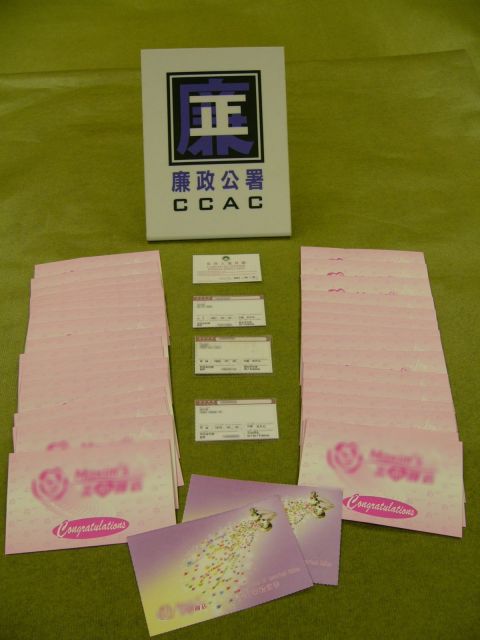


 After about three months¡¦ investigation, the CCAC revealed a case of organized crime allegedly relating to illegal retention of voter cards. Certain people were suspected of offering advantages in the form of money or cake coupons, intending to induce voters to hand in their voter cards and to influence their voting decisions in the Legislative Council Election on 25th September. Twenty-one suspects, including one candidate of a group in the Election, were involved in the case. The case was transferred to the Public Prosecutions Office today (6th September)
Category: Anti-Corruption Work Clean Elections Release method: Press Releases
 Release:2005/09/06
After about three months' investigation, the CCAC revealed a case of organized crime allegedly relating to illegal retention of voter cards. Certain people were suspected of offering advantages in the form of money or cake coupons, intending to induce voters to hand in their voter cards and to influence their voting decisions in the Legislative Council Election on 25th September. Twenty-one suspects, including one candidate of a group in the Election, were involved in the case. The case was transferred to the Public Prosecutions Office today (6th September).
In May 2005, the CCAC received complaints indicating that some people were illegally retaining voter cards. During investigation, the CCAC kept receiving similar complaints from a number of citizens. In subsequent CCAC operations, investigators seized a number of voter cards and a large quantity of voter card related documents from a company, and a batch of cake coupons from an association. Thorough investigation revealed that someone, who was prepared to run in the Legislative Council Election, had allegedly organized people, promised to pay MOP500 for each voter card collected in order to influence voters' decisions. The "organizers" even distributed cake coupons, as a sign of sincerity, to attract people.
The CCAC discovered that the voter cards were collected through a pyramid scheme, which is multi-layered, with 'middlemen' at each layer collecting voter cards independently. All of the cards would eventually be submitted to the top layer for "centralized processing". The scheme had been expanded to the fifth layer and on its way to the sixth when the case was revealed. The CCAC had summoned many people to assist in the investigations. A third of the twenty-one suspects were allegedly serving as 'middlemen'.
During investigation, someone admitted to having collected voter cards and distributed advantages. It was also found that the certain key people, surnamed "Ng", "Sun", "Hoi" and "Yip", had formed a defensive alliance and had discussed ways to cope with law enforcement departments.