
 Launching Ceremony of Collected Essays of Conference "Prevention and Suppression of Corruption in the Private Sector: Reality and Foresight" and Seminar on Corruption Prevention in the Private Sector
Category: Promotion and Education Exchange and Training Release method: Press Releases
 Release:2010/02/23
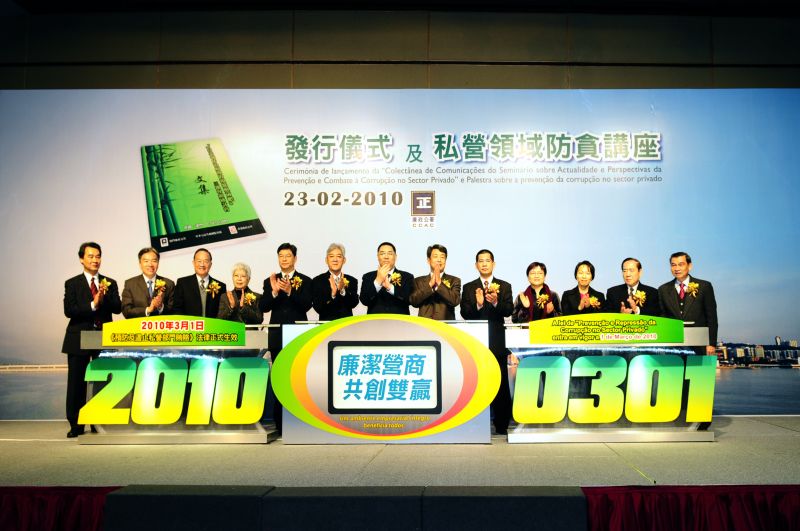
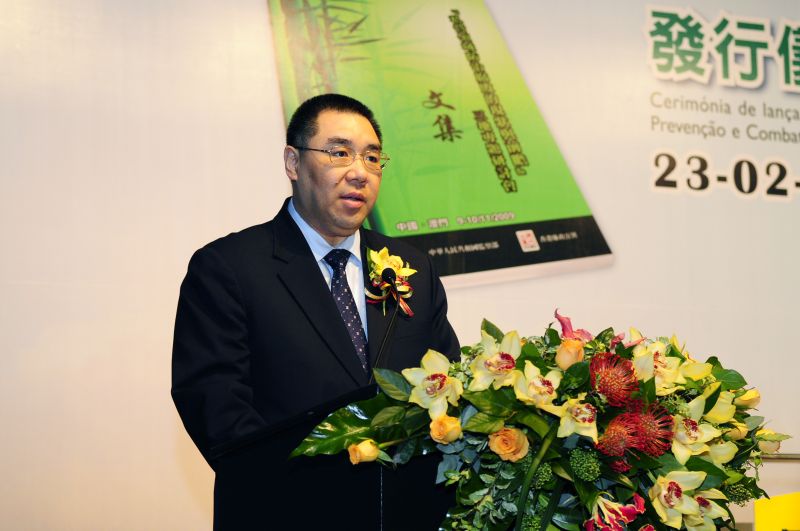
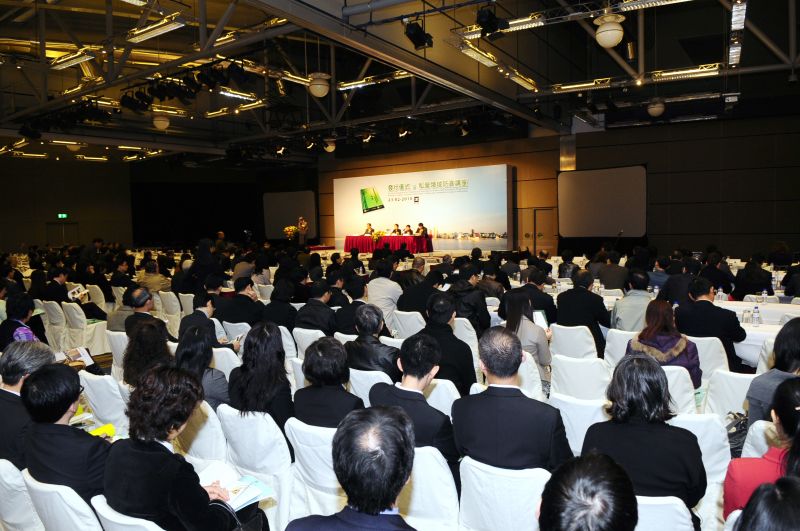
The CCAC held the Launching Ceremony of Collected Essays of Conference "Prevention and Suppression of Corruption in the Private Sector: Reality and Foresight" on 23rd February at Macau Tower Convention & Entertainment Centre. The Chief Executive, Chui Sai On, officiated the ceremony and delivered a speech, expressing the Macao SAR Government's concern for corruption prevention. At the same time, the CCAC also held the Seminar on Corruption Prevention in the Private Sector during which around 500 experts from various fields and representatives of political and commercial associations from Macao shared the experiences in promoting integrity management and business ethics in the private sector with delegates of anti-corruption agencies of Mainland China and Hong Kong and representatives of the commercial sector in Hong Kong.
Since the law Prevention and Suppression of Bribery in the Private Sector will enter into force on 1st March 2010, last year the CCAC initiated a series of promotion of the new law, including the Conference "Prevention and Suppression of Corruption in the Private Sector: Reality and Foresight" co-organized with the Ministry of Supervision of the People's Republic of China and the ICAC of Hong Kong in late November last year. During the conference, the graft-fighting agencies and representatives of private enterprises had an in-depth discussion of the supervisory mechanism, measures on corruption prevention and integrity building. In order to share the achievements of the conference with the general public and strengthen their awareness of integrity and law-abidingness, the CCAC published the speeches and essays.
The Launching Ceremony was officiated by the Chief Executive, Chui Sai On, President of the Legislative Assembly, Lau Cheok Va, Deputy Director General of the General Office of National Bureau of Corruption Prevention of China, Yu Xiancheng, Prosecutor General of the Public Prosecutions Office, Ho Chio Meng, the Commissioner Against Corruption, Fong Man Chong, Member of the Monitoring Committee for the Discipline of the CCAC Personnel, Paula Ling, Director of Community Relations of the ICAC, Julie Mu Fee-Man, Director of the Research Centre for Sustainable Development Strategies, Tse Chi Wai, Deputy Commissioner Against Corruption, Endy Tou, President of the Chinese Manufacturers' Association of Hong Kong, David Y. K. Wong, President of Board of Directors of the Macau Chamber of Commerce, Hoi Sai Iun, Director of Macao Federation of Trade Unions, Chan Kam Meng, and Director of Macao General Union of Neighbourhood Associations, Io Hong Meng.
In his speech, the Chief Executive said that the Legislative Assembly's approval of the law Prevention and Suppression of Bribery in the Private Sector in 2009 signified that prevention and combat of corruption in the private sector was a social consensus. He recognized the CCAC's efforts on conducting holistic promotions, assisting different sectors in formulation of integrity management rules and its strategies to join hands with the guilds, the media, the citizens and the society to construct its corruption-prevention network. He also said that the government would co-operate with the CCAC to promote integrity management among local enterprises and establish a clean and fair business environment.
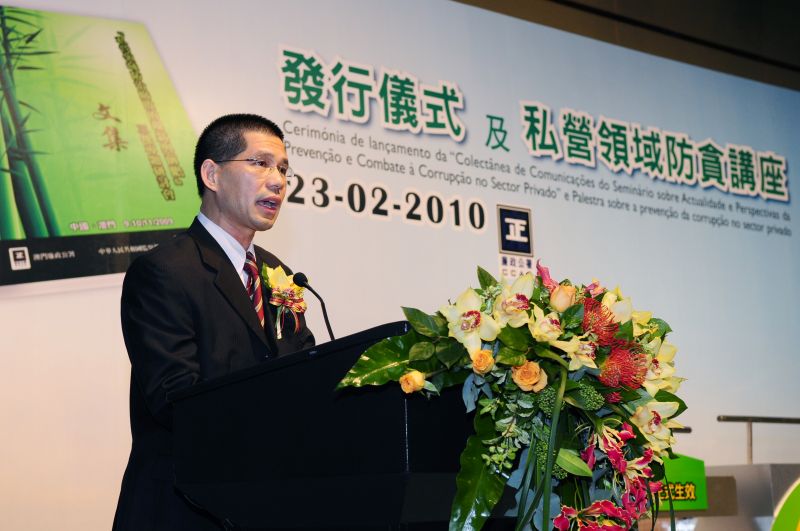
The Commissioner, Fong Man Chong, thanked the speakers of the conference for their contribution to integrity building in the private sector. He stated that the entry into force of the law Prevention and Suppression of Bribery in the Private Sector has 3 significant meanings, including: 1) The fulfillment of the Macao SAR's international obligation brought by the application of the United Nations Convention Against Corruption by expanding the anti-corruption jurisdiction to the private sector, so that Macao's legal system will be elevated to the international standard; 2) To encourage the competitors in the free market (entrepreneurs) to have a fair competition under the prerequisite of observance to "the principles of justice and honesty" with an aim to establish a clean business environment; 3) To enhance the development of employment culture in a more transparent and healthy direction so that employers and employees will treat each other honestly under the principle of good faith and eradicate the old bad practice of disloyalty for personal interest.
Regarding the promotion of the new law, as a short-term goal, Fong Man Chong pointed out that the CCAC will continue to strengthen the promotion to the general public as well as directly communicate with the representatives of relevant sectors in order to gather information for formulating codes of conduct applicable to different sectors with an aim to create a society of order.
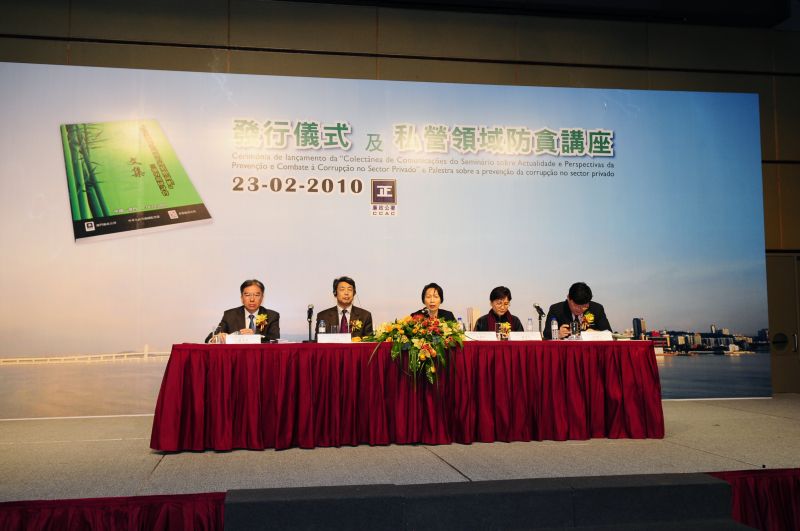
Hosted by Deputy Commissioner, Endy Tou, the Seminar on Corruption Prevention in the Private Sector was held after the launching ceremony. The guest speakers included Deputy Director General of the General Office of National Bureau of Corruption Prevention of China, Yu Xiancheng, Director of Community Relations of the ICAC, Julie Mu Fee-man, President of the Chinese Manufacturers' Association of Hong Kong, David Y. K. Wong, and Vice Rector of the University of Macau, Prof. Simon S.M. Ho.
During the seminar, Yu Xiancheng introduced the main functions of the National Bureau of Corruption Prevention of China and the bureau's coordination and direction of the work on corruption prevention in the private sector in China. Julie Mu Fee-Man, talked about the history of the ICAC's fight-against-corruption in the private sector and shared its experience. She stressed the importance of partnership with different sectors to the enhancement of corruption prevention in the private sector. David Y. K. Wong talked about the significance of integrity to the enhancement of an enterprise's competitiveness and social development. He also brought out suggestions about corruption prevention. Finally, Prof. Simon S.M. Ho discussed with participants how to reconstruct the core value of free economy and corporate governance after the world experienced the global financial crisis.